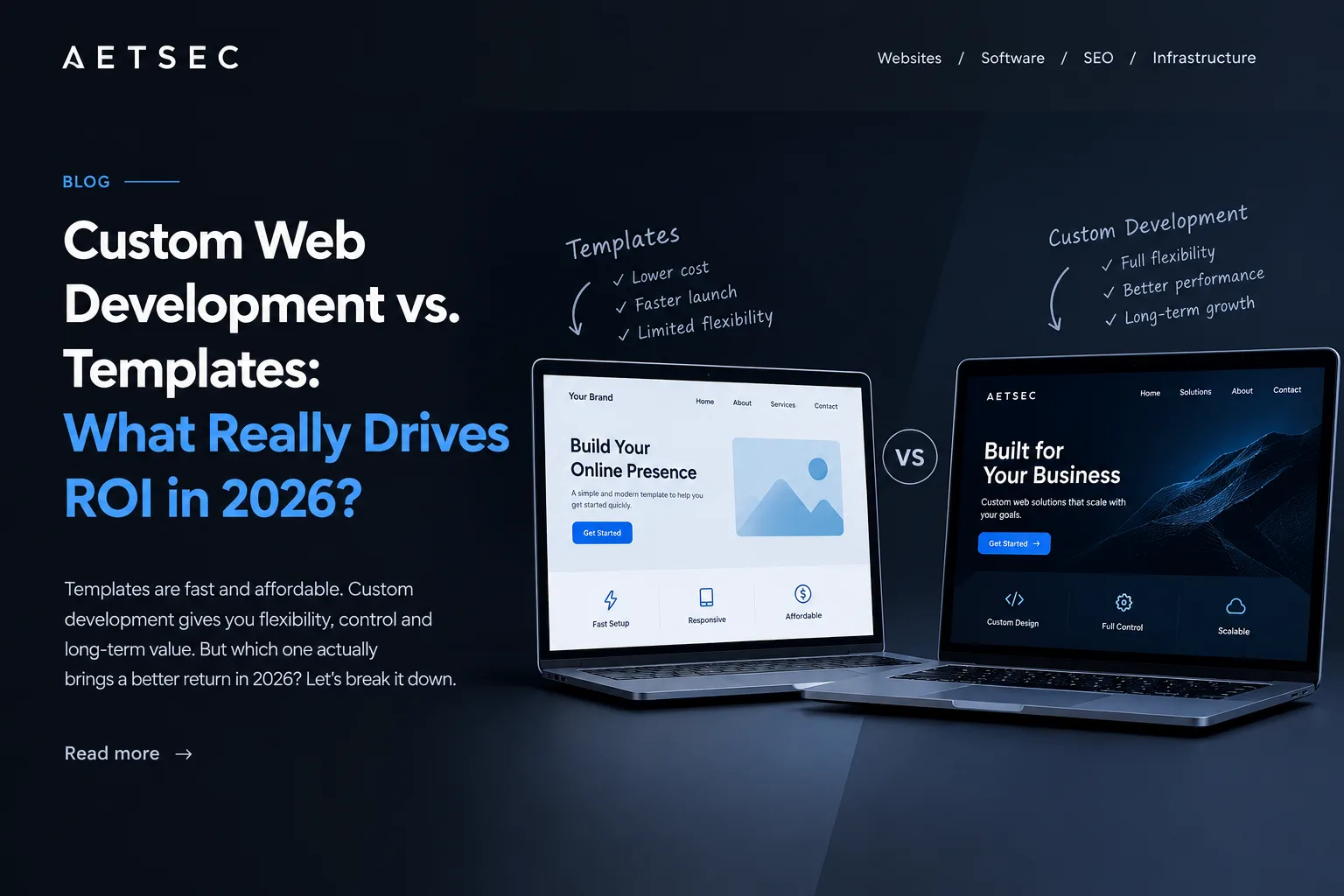
Custom Web Development vs. Templates: What Really Drives ROI in 2026?
When building a website, one of the first decisions you'll face is whether to use a ready-made template or build something custom.
Templates are everywhere. They're affordable, quick to set up, and can make a website look professional without a large budget. Custom development, on the other hand, gives you more control over how your website looks, works, and grows with your business.
So, which one is actually worth the investment in 2026?
The honest answer is that it depends on what you're building, what you can spend, and where you want your business to go.
What Are Template-Based Websites?
A template-based website uses a pre-designed layout that you customize with your own content, branding, images, and features.
Platforms like WordPress, Shopify, and Webflow offer themes and templates that make launching a website much easier. You don't have to build every page from scratch, and many common features are already available.
For a small business that needs a professional online presence, this can be a great starting point.
The biggest advantage is getting online quickly without spending too much.
However, templates come with limitations. You might find it difficult to change certain layouts, implement a specific feature, or create an experience that feels different from other websites using the same theme. Adding too many plugins or workarounds can also make maintenance more complicated.
That doesn't mean templates are bad. It simply means they're designed to serve a broad range of needs, not necessarily every requirement your business might have.
What Is Custom Web Development?
Custom web development means building a website around your specific requirements instead of relying entirely on a pre-designed layout.
The design, functionality, integrations, and user experience can all be planned around how your business operates and what your customers need.
For example, a business might need a custom booking system, a customer dashboard, integration with internal software, or a unique purchasing process. If existing themes and plugins can't handle these requirements properly, custom development may be the better option.
It also gives you greater control over the website's structure and future development.
But there's a trade-off: custom projects usually require more planning, development time, testing, and upfront investment. If your requirements aren't clear, costs can increase as the project evolves.
Custom development makes the most sense when the business needs justify the additional investment.
The Real Difference: Upfront Cost vs. Long-Term Value
It's easy to compare the initial prices of two websites. It's harder to compare what they'll cost and deliver over the next few years.
A template might be cheaper to launch, but you may eventually spend money on premium plugins, additional functionality, performance improvements, or workarounds for features the theme wasn't designed to support.
A custom website may cost more initially, but it can be designed around your actual requirements from the beginning.
Neither option automatically offers a better return on investment (ROI). The result depends on how well the website supports your business.
Consider these factors:
FactorTemplate-Based WebsiteCustom WebsiteInitial investmentUsually lowerUsually higherTime to launchGenerally fasterUsually takes longerDesign flexibilityDepends on the theme and platformGreater controlSpecial functionalityOften relies on plugins or available featuresCan be built to specific requirementsMaintenanceDepends on the platform, theme, and pluginsDepends on the architecture and implementationFuture growthCan scale well within its limitationsCan be designed around planned growthBest suited forStandard business websites and online storesUnique requirements and complex functionality
These are general differences, not guarantees. A well-built template website can outperform a poorly developed custom one, and a custom project can become expensive if it's unnecessarily complicated.
Does Custom Development Improve SEO?
Not automatically.
A common misconception is that custom-built websites rank better on Google simply because they're custom. In reality, search performance depends on several factors, including useful content, technical accessibility, site structure, page speed, mobile usability, and the overall experience visitors receive.
A well-configured WordPress website can perform very well in search results. A custom website can also struggle if its pages are poorly structured, its content is weak, or search engines can't properly crawl it.
The advantage of custom development is the ability to make technical decisions around your requirements. You can control how pages are structured, how assets are loaded, and how different features are implemented.
Templates can provide many of these benefits too, provided they're configured properly.
If SEO matters to your business, choose the approach that allows you to build and maintain a technically sound website—not simply the one labelled "custom."
What About Website Speed and Performance?
Website performance matters because people don't want to wait for a page to load. A slow or frustrating experience can cause visitors to leave before they contact you or make a purchase.
Custom development gives developers more control over the code, scripts, images, and resources a website uses. This can help avoid unnecessary functionality and improve performance.
But custom code isn't automatically fast. Poor coding, oversized images, inefficient database queries, and inadequate hosting can slow down any website.
Templates can also be fast when they're lightweight, well-maintained, and configured correctly.
Before investing in a complete rebuild, check what's actually slowing your current website down. Better image optimization, improved hosting, caching, or removing unnecessary plugins might solve the problem without starting over.
Which Option Delivers Better ROI in 2026?
Let's look at three common situations.
1. You're launching a small business
You need a website that explains your services, builds trust, and helps customers contact you.
A template-based website is often the sensible choice. You can launch sooner, control your initial costs, and invest more of your budget in good content, marketing, and customer acquisition.
There's little benefit in paying for a complex custom build if a simpler website already meets your needs.
2. You're building an online store
If you're selling standard products, a platform such as Shopify or WooCommerce may provide everything you need to get started.
As your business grows, you might need custom checkout behaviour, specialized integrations, or a more tailored customer experience. At that point, extending your existing store or investing in custom development may become worthwhile.
The right decision depends on whether the limitations of your current setup are affecting sales, operations, or future plans.
3. You're building a SaaS product or a complex platform
This is where custom development can offer a clearer advantage.
If your product requires user accounts, dashboards, subscriptions, business-specific workflows, or integrations between multiple systems, a generic template may not be enough.
You're not simply building a website anymore. You're building a product that people will use to accomplish specific tasks.
In this situation, investing in the right architecture and functionality from the beginning can help avoid costly workarounds later. Even then, starting with a smaller version of the product and expanding based on real user feedback is often smarter than building everything at once.
How to Make the Right Decision
Before choosing a template or custom development, ask yourself a few questions:
- What does the website need to achieve? More enquiries, online sales, customer support, or an entirely new digital product?
- Can an existing platform meet those needs? If it can, there's no reason to add unnecessary complexity.
- What will the business need in the next few years? Consider realistic plans rather than building for every possible future scenario.
- Where will the budget create the most value? Sometimes better content or marketing will produce a greater return than a more sophisticated website.
- How easy will it be to maintain? Consider hosting, updates, security, integrations, and the people responsible for managing the site.
Your answers will give you a much clearer picture of which approach makes sense.
Final Thoughts
The debate between custom web development and templates isn't really about which technology is better. It's about choosing the right solution for the problem you're trying to solve.
Templates are an excellent way to launch quickly and keep costs under control. Custom development becomes more attractive when your business needs functionality, flexibility, or control that existing solutions can't provide efficiently.
The best investment isn't necessarily the website that costs the most or has the most features. It's the one that helps your business reach its goals without creating unnecessary costs along the way.
At AETSEC, we believe technology should be built around your business—not the other way around. Whether you need a straightforward business website, an online store, or a custom digital platform, the first step is understanding what you actually need.
Have a project in mind? Let's find the right approach for it.
Visit Aetsec.com to get started.